RANSOM_SYSTEM.THAAOEAH

Gen:Variant.MSILPerseus.170079 (BitDefender), MSIL/Filecoder.PP!tr.ransom (Fortinet), Trojan:Win32/Tiggre!rfn (Microsoft)
Windows




Threat Type: Ransomware
Destructiveness: No
Encrypted: No
In the wild: Yes
OVERVIEW
This Ransomware arrives on a system as a file dropped by other malware or as a file downloaded unknowingly by users when visiting malicious sites.
It encrypts files with specific file extensions. It encrypts files found in specific folders.
TECHNICAL DETAILS
Arrival Details
This Ransomware arrives on a system as a file dropped by other malware or as a file downloaded unknowingly by users when visiting malicious sites.
Autostart Technique
This Ransomware adds the following registry entries to enable its automatic execution at every system startup:
HKCU\Software\Microsoft\
Windows\CurrentVersion\Run
System = {malware path}\{malware file}.exe
Process Termination
This Ransomware terminates the following processes if found running in the affected system's memory:
- taskmgr
- regedit
- ProcessHacker
Other Details
This Ransomware does the following:
- After encrypting files it display the following:
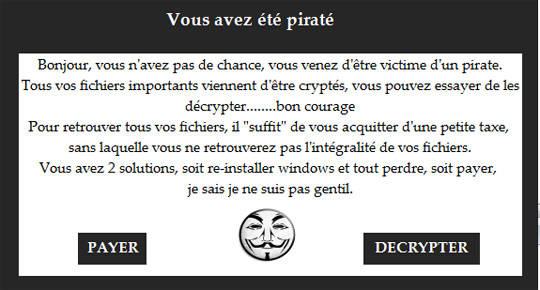
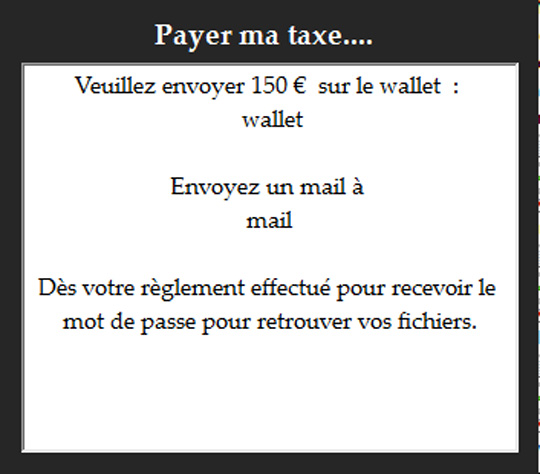
If Payer clicked:
If Decrypter clicked:
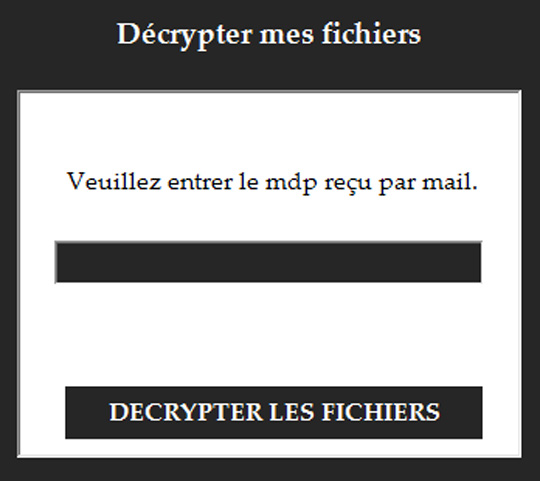
- If you input letters "mdp" and clicked the button it will start to decrypt all the encrypted files and created autorun registries.
Ransomware Routine
This Ransomware encrypts files with the following extensions:
- .txt
It encrypts files found in the following folders:
- D:\rsw
It appends the following extension to the file name of the encrypted files:
- .encrypt
SOLUTION
Step 1
Before doing any scans, Windows XP, Windows Vista, and Windows 7 users must disable System Restore to allow full scanning of their computers.
Step 2
Note that not all files, folders, and registry keys and entries are installed on your computer during this malware's/spyware's/grayware's execution. This may be due to incomplete installation or other operating system conditions. If you do not find the same files/folders/registry information, please proceed to the next step.
Step 3
Delete this registry value
Important: Editing the Windows Registry incorrectly can lead to irreversible system malfunction. Please do this step only if you know how or you can ask assistance from your system administrator. Else, check this Microsoft article first before modifying your computer's registry.
- In HKEY_CURRENT_USER\Software\Microsoft\Windows\CurrentVersion\Run
- System = "{Malware path}\{malware file}.exe"
- System = "{Malware path}\{malware file}.exe"
Step 4
Scan your computer with your Trend Micro product to delete files detected as RANSOM_SYSTEM.THAAOEAH. If the detected files have already been cleaned, deleted, or quarantined by your Trend Micro product, no further step is required. You may opt to simply delete the quarantined files. Please check the following Trend Micro Support pages for more information:
Step 5
Restore encrypted files from backup.
Did this description help? Tell us how we did.